Cut
How well the facets are proportioned and polished. Cut drives sparkle more than any other C — prioritise Excellent or Very Good.
The 4Cs, lab-grown vs natural, what a certificate tells you and how metal purity works — everything in one place.
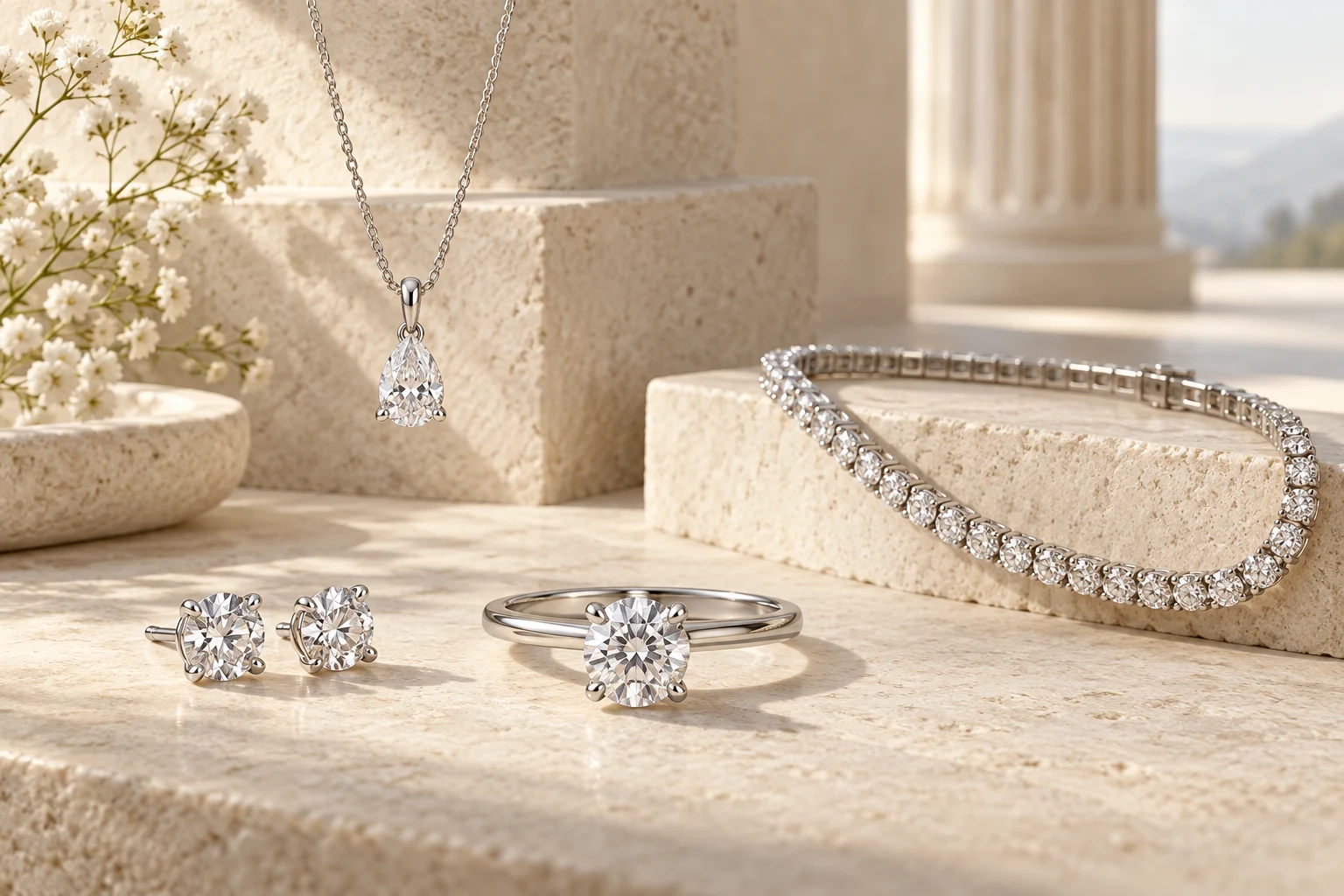 CUT · COLOR · CLARITY · CARAT
Grading labs describe diamonds using four characteristics. Together they drive how a stone looks and what it costs.
How well the facets are proportioned and polished. Cut drives sparkle more than any other C — prioritise Excellent or Very Good.
Graded D (colorless) to Z (light yellow). G–H looks colorless to most eyes in white metal; warmer grades suit yellow gold.
Inclusions seen under 10× magnification, from FL (flawless) to I3. VS2–SI1 is often "eye-clean" and good value.
A weight measure: 1 carat = 0.2 grams. Two stones of the same carat can look different sizes depending on cut and shape.
| Grade | What it means | Good to know |
|---|---|---|
| D – F | Colorless | Rarest color range; the difference is hard to see once set. |
| G – J | Near colorless | Looks white face-up; popular value choice. |
| K – M | Faint color | Warm tint that suits yellow and rose gold. |
| FL – IF | Flawless / internally flawless | No inclusions visible at 10×. Very rare. |
| VVS1 – VS2 | Very very / very slightly included | Inclusions hard to find even under magnification. |
| SI1 – SI2 | Slightly included | Often eye-clean; check the specific stone. |
| I1 – I3 | Included | Inclusions may be visible without magnification. |
Lab-grown diamonds are real diamonds — the same carbon crystal, hardness and sparkle as natural diamonds — grown in a controlled environment instead of formed underground over billions of years. Both are graded on the same 4Cs.
A grading report (certificate) is an independent lab's assessment of a specific stone. Always match the report number to the laser inscription on the girdle.
Reports from recognised labs such as GIA and IGI are widely trusted and consistent.
A unique number you can verify on the lab's website — and often inscribed on the stone.
Shape, measurements, 4Cs, polish, symmetry and fluorescence, with a plot of inclusions.
Reports state whether a diamond is natural or laboratory-grown, and note any treatments.
Karat measures how much pure gold is in an alloy. Higher karat means richer color and softer metal; lower karat is more durable for everyday wear.
| Metal | Purity | Hallmark | Best for |
|---|---|---|---|
| 10K gold | 41.7% gold | 417 | Durable, budget-friendly everyday pieces |
| 14K gold | 58.5% gold | 585 | The balance of color and durability — most popular |
| 18K gold | 75% gold | 750 | Richer color, fine jewelry and engagement rings |
| 24K gold | 99.9% gold | 999 | Too soft for most set jewelry |
| Platinum | 95% platinum | PT950 | Naturally white, dense and hypoallergenic |
| Sterling silver | 92.5% silver | 925 | Fashion pieces; tarnishes over time |
White gold is usually rhodium-plated for a bright white finish; plating may need refreshing every year or two.